
Stop Slandering Retinol
A practical guide to avoiding hogwash on the internet.

There are plenty of things to worry about in the 21st century, but one sits at the top of my list: lies are wildly entertaining. The truth? Boring as sin.
Back in 1710, Jonathan Swift wrote in The Examiner1 that “falsehood flies, and the truth comes limping after it.” Three hundred years later, the observation still holds, we’ve just turbocharged how lies spread with social media, platforms that prioritize entertainment over accuracy.
Take sunscreen. Researchers2 analyzed more than 1,000 TikTok videos tagged with the five most popular sunscreen-related hashtags. Seemingly, there was good news, the overwhelming majority — 87% — promoted sunscreen use. The logical conclusion would be…accurate information dominates, right?
Of course not. The researchers found that videos which doggedly criticize sunscreen pulled significantly more likes, shares, and comments than the ones promoting it. This engagement signals to the algorithm that it’s popular. As a result, the lies got shown more. Conspiracy theories tend to be engrossing, more viral and generate far more engagement than scientifically sound arguments3.
TLDR; there is an overwhelming amount of garbage claims to sift through online. Unless if you have “digital health literacy,” defined by the TikTok study researchers as an ability and access to resources to find and look at health claims well enough to make good decisions, you’re doomed to getting scammed on the internet. So let’s talk about how to counter that.
A Practical Guide To Avoiding Digital Balderdash
I like to picture the internet as the wilderness. Considering it triggers our fight or flight response, might as well4. Men with mini mics are akin to poisonous mushrooms, do not consume or consider for too long. Links in bio to supplements are sleeping bears, so run. And claims around non-toxic products are a sudden storm; seek mental shelter away from them. There are patterns and cues that salespeople — who have cleverly positioned themselves as wellness influencers and coaches — always give off, which can help you avoid the dangers of the internet.
Which brings me to the panicked DM I got about retinol.
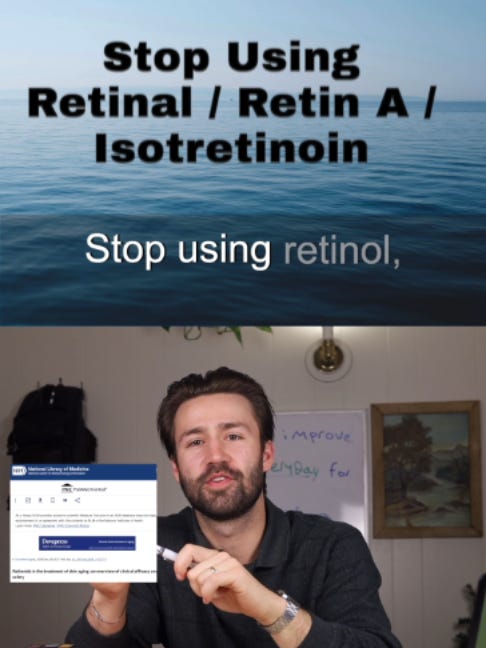
“IS THIS REAL??” Followed by a link to a video on TikTok. I scrolled through my mentions and had received about 10 tags on the same video.
When I saw the preview thumbnail, I didn’t even need to click to know I was about to get into some biohacking nonsense that would inevitably raise my blood pressure. So, let’s deep dive into all the crimson flags of the viral post @taylorloveshealth created. Maybe you can share these tips with a loved one who gets sucked into the wellness-to-QAnon pipeline.
Before we even get to the post, let’s start with his profile.
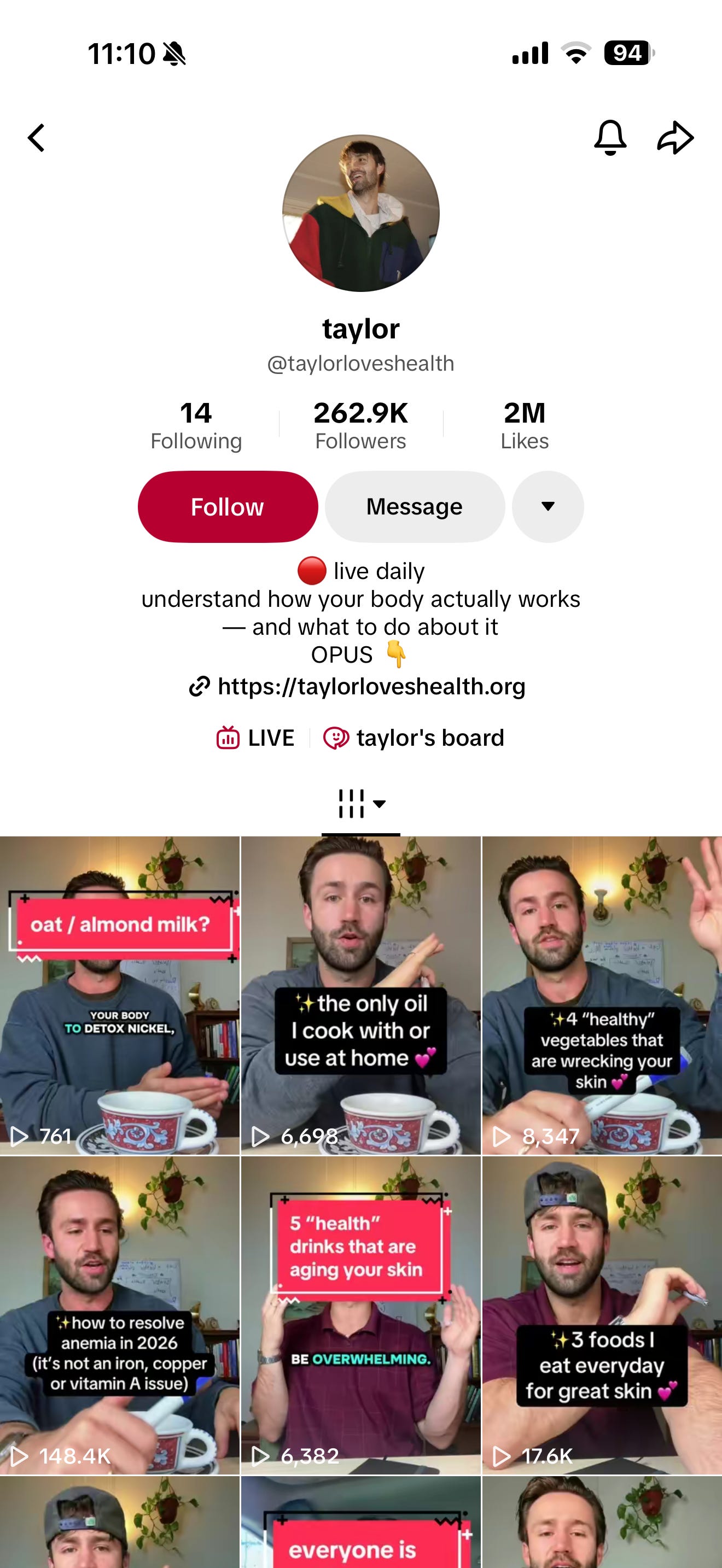
He’s a health coach. I wasn’t quite sure what that meant so I did some digging.
Taylor is less of a health coach and more of a salesman. His “integrative” health courses that promise to teach you how to “ascend” your health are vague, and it’s pay to play. He has no credentials, no training from what I can see on the website, just vibes and some anecdotes.
None of that stopped his retinal misinformation video from racking up 700,000+ views and 25,000+ likes.
So, let’s break down why his post is wrong, and why the solution, conveniently, is to buy his ‘courses.’
 Tiktok failed to load.
Enable 3rd party cookies or use another browser
According to Taylor:
Retinoids work short-term for looks.
He claims retinoids damage people’s skin and health over the long run.
He recommends people get off retinoids to “improve” their health.
His main piece of evidence is a study that was halted after a few years due to concerns around death.5
The study Taylor leans on is the Veterans Affairs Topical Tretinoin Chemoprevention (VATTC) Trial. It ran from 1998 to 2004 and was published in 2009. 6
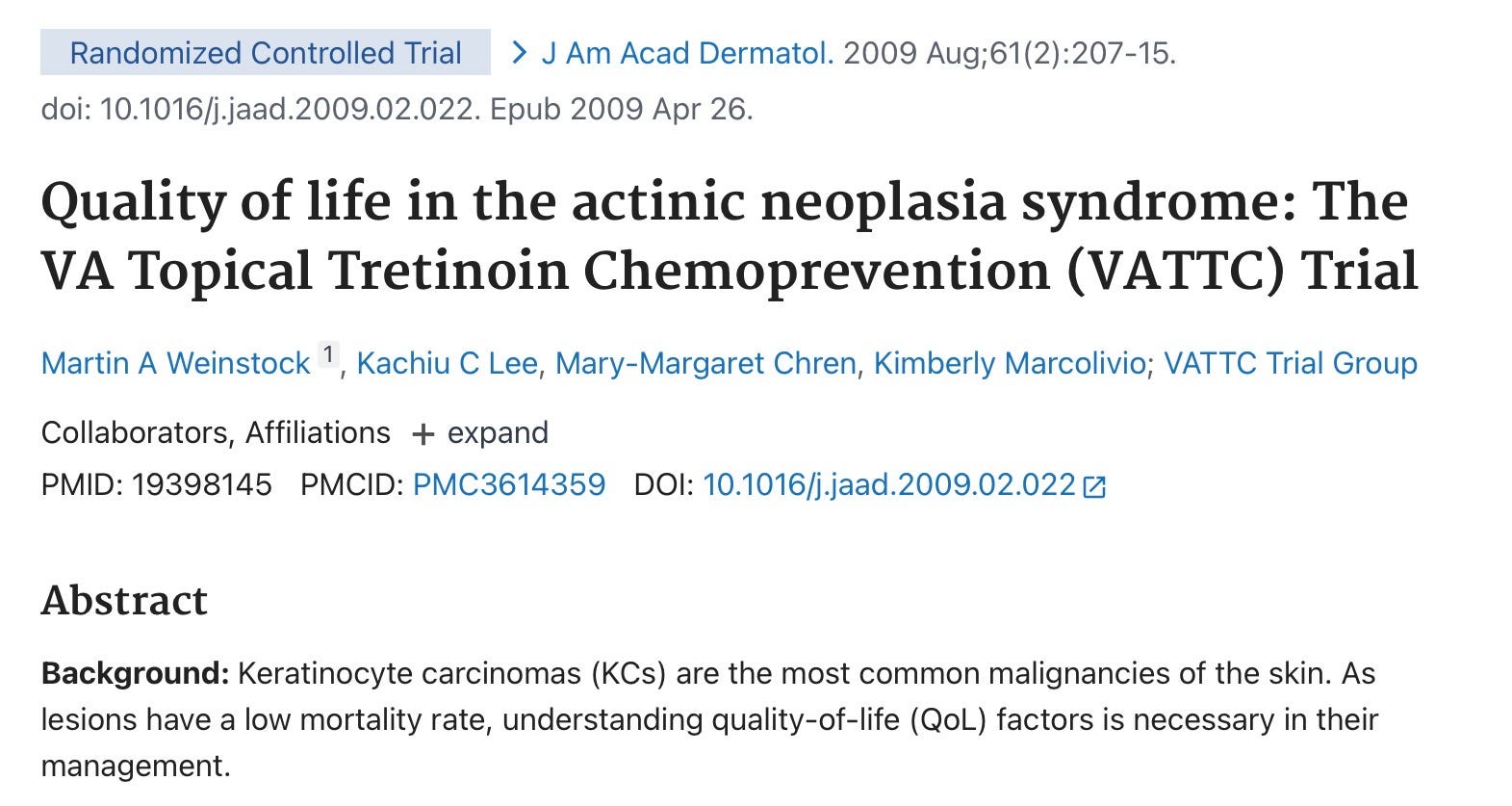
Some important considerations of the study:
1,131 veterans were enrolled. 97% were men, and the average age was 71.
That’s an old, overwhelmingly male cohort… and this group skewed toward smokers. US life expectancy for men sits around 75 to 76. Over a multi-year study, some of these men dying isn’t exactly shocking.
More men did die in the tretinoin group than in the placebo group (because there were deaths in BOTH groups), and the difference was statistically significant… but… there’s a but.
The causes of death were all over the map, lung cancer, vascular disease, respiratory and chest problems. The cause of death was more associated with well established complications caused from smoking.
And the researchers themselves? They explicitly warned against the conclusion the coach is drawing, writing that the trial was not reason to hesitate about using topical tretinoin in practice without additional evidence (since the study didn’t prove anything). This study was done almost two decades ago, no research has even hinted at what Taylor suggests.
To double down on the point, an article from 2009 interviewed the researchers:
"We didn't see any evidence for a cause-and-effect relationship," said Dr. Martin Weinstock, chief of dermatology at VA Medical Center in Providence, R.I., and a professor of dermatology and community health at Brown University, also in Providence.
So a health coach is going to weaponize a study to sell his courses, while ignoring what the study’s own authors concluded? Moments like this remind me, we live in a special kind of ignorant hell. We have random people using a study for legitimacy yet refuse to actually listen to the authors of the study.
I cannot stress this enough, be so wary of people on the internet telling you “the truth.” Especially when it contradicts decades of established research. Taylor didn’t discover anything, he just can’t read or interpret studies properly.
Why retinoid slander is a particularly annoying take from the biohacker bros…
If you made it past the beginning of Taylor’s “research” you’d know he went on to spread the same tired myths of retinoids. Things like…
“Retinoids thin your epidermis.” Which, no7. Retinoids thicken the epidermis and restructure your skin’s top layer so it’s stronger than it would be without them.
“Retinoids permanently sensitize your skin and let pathogens into your bloodstream.” The sensitivity is real, but temporary. Dr. Albert Kligman — the dermatologist who pioneered topical tretinoin — documented that once you get past the “retinol uglies” (the dry, flaky adjustment phase), that sensitization fades. Long-term, retinoid use make your skin barrier stronger, not weaker.
Taylor goes on to say…“The only real way to fix your skin is my website.” Convenient.
Look, you don’t have to use retinoids. You don’t have to use tretinoin. Not everyone cares about having stronger skin or beauty standards around having smoother skin.
But it’s a special kind of stupid if you’re into longevity science and then trash one of the only proven ingredients that keeps skin acting younger.
Retinoids do the very things we associate with younger skin: they signal fibroblasts to make more collagen, they speed up cell turnover, and they help skin heal faster from injury. I find the ever-escalating beauty standards exhausting too, but that doesn’t change the fact that vitamin A derivatives are safe and genuinely effective.
How to navigate the hellscape of social media:
If someone’s selling you something, be skeptical. They have an incentive to bend the truth. That includes me, I have to fight the urge to oversell daily. That’s ok, I’m human.
If someone’s trashing an expert consensus in a field they have no expertise in, be skeptical. They aren’t truth tellers…

Lastly, is that talking head even a real live person? AI is a whole new flood of nonsense. A reminder, doctors are being impersonated, random people’s identities are being stolen, it’s getting weird out here.
In today’s internet, don’t trust your eyes and ears by default. Learn to double-check, and look for what the actual experts say. In this case, who ran that study Taylor wanted us to pay attention to? Epidemiologists and dermatologists. Not a single health coach in sight.
Keep tagging me in the most viral misinformation you find, and I’ll continue to debunk it. Because lies may travel faster, but I still believe the truth catches up.
Citations, Please:
“Issue 14 of “the Examiner” 9/11/1710.” Www.ourcivilisation.com, www.ourcivilisation.com/smartboard/shop/swift/examiner/chap14.htm.
Marcon, Alessandro, et al. “Sunscreen Is Overwhelmingly Promoted on TikTok, but Content with Misinformation Exhibits Proportionally High Levels of Audience Interaction.” PLOS Digital Health, 18 June 2026, https://doi.org/10.1371/journal.pdig.0001440.
Zeng, Jing, et al. “Conspiracy Theories in Digital Environments: Moving the Research Field Forward.” Convergence: The International Journal of Research into New Media Technologies, vol. 28, no. 4, Aug. 2022, pp. 929–939, https://doi.org/10.1177/13548565221117474.
Salamon, Maureen. “Doomscrolling Dangers.” Harvard Health, 1 Sept. 2024, www.health.harvard.edu/mind-and-mood/doomscrolling-dangers.
A quick caveat: I don’t think anyone should be reading clinical studies solo unless they’re trained for it, most Americans read at or below a sixth-grade level. Thankfully, this study had a wave of press around it, and the researchers unequivocally gave their feedback so there’s absolutely zero mystery about what happened with this study.
Weinstock, Martin A., et al. “Topical Tretinoin Therapy and All-Cause Mortality.” Archives of Dermatology, vol. 145, no. 1, 2009, pp. 18–24, https://doi.org/10.1001/archdermatol.2008.542.
Weiss, Jonathan S., et al. “Topical Tretinoin Improves Photoaged Skin.” JAMA, vol. 259, no. 4, 1988, pp. 527–32.